How to Handle Difficult Airbnb Guests Without Losing Your Mind (A Host’s Guide)
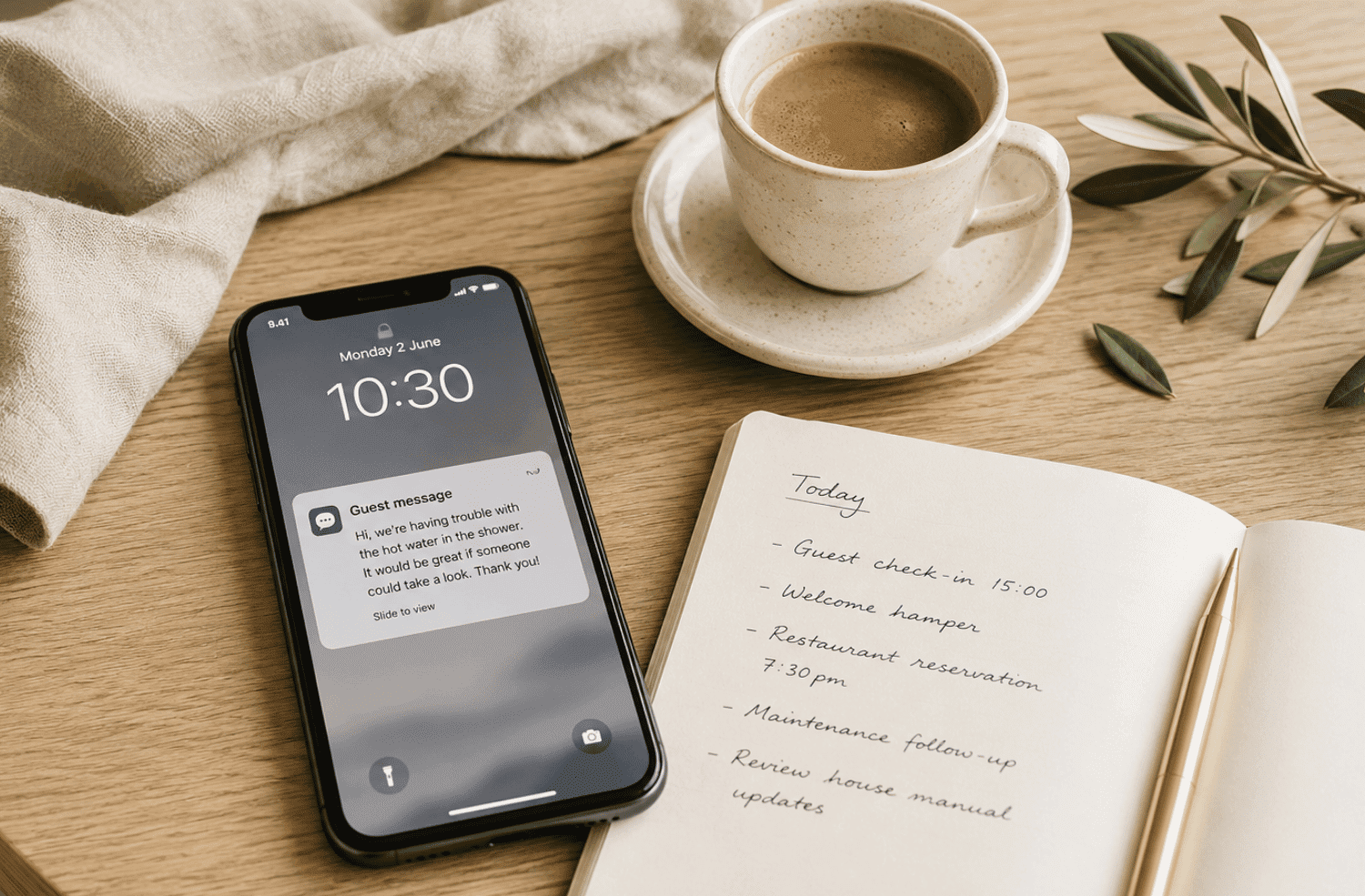
It’s 10:47 PM. You’re already in bed. Your phone lights up with a message from a guest who checked in three hours ago.
“The apartment is nothing like the photos. We are very disappointed. This is unacceptable.”
Your stomach drops.
Your mind races.
You want to defend yourself, explain, apologise, fix it — all at once.
Here’s the truth: it happens to every host. Even the best ones. Even the ones with immaculate properties and 4.9 ratings and years of experience.
If you’ve hosted long enough, you’ve probably already discovered this yourself: problems are not the exception. They are part of the job.
A guest can’t find the lockbox.
The cleaner misses something.
The guest expected one thing and experienced another.
The goal isn’t to avoid every problem. The goal is knowing what to do when one inevitably appears.
This post is about exactly that. The real, practical, research-backed approach to getting through difficult guest situations — without losing your mind, your rating, or your dignity.
I’ll be honest — this is not a quick read.😄 Grab a coffee, settle in, or simply jump to the section you need most using the table of contents below.
First: Why Guests Actually Become Difficult
Before we talk about what to do, it helps to understand what’s actually happening when a guest gets angry.
Most of the time, it’s not really about the broken hairdryer.Guests become difficult when there’s a gap between what they expected and what they actually experienced — and then they interpret that gap as unfair, careless, or preventable. That last part matters. It’s not just disappointment. It’s the feeling that someone could have prevented this and didn’t.
Research also shows that guests become significantly harder to deal with when they feel unheard. A guest who feels listened to often becomes easier to help. A guest who feels dismissed usually becomes more difficult, even when the host is technically right.
Understanding this changes everything. Your first task isn’t proving you’re right. It’s helping the guest feel heard.
The Best Conflict Technique Is Prevention
This sounds obvious, but it’s worth saying clearly: the complaint you never receive is the one you already solved.
A clean, well-organised property actually reduces complaint intensity even when something does go wrong. Why? Because it signals professionalism. When guests are already comfortable and impressed, they’re less likely to interpret a small problem as evidence of general incompetence.
Your listing also does a lot of the work — or fails to do it — long before guests arrive. Vague descriptions, flattering-but-misleading photos, and grand promises are conflict seeds.
The practical lesson: promise carefully. Describe accurately. Avoid grand guarantees in favour of specific, credible ones.
A few things worth having ready before peak season:
- One clear channel for urgent guest issues (a phone number, WhatsApp, whatever works for you — but one thing, not three)
- Pre-written response templates for your most common situations, so you’re not composing from scratch at midnight
- A simple remedy framework — know in advance what you’ll offer for a minor issue, a moderate one, and a serious one. Decision fatigue under pressure leads to either over-compensating or under-responding.
Also worth knowing: Airbnb expects hosts to respond within roughly one hour for time-sensitive issues close to check-in. Guests have 72 hours to report problems. That means the first two hours of any problem matter enormously — being ready before high season starts is not optional.
Want to Prevent Guest Problems Before They Starts?
Many guest complaints don’t begin with a major problem. They begin with uncertainty.
A guest can’t find the property. The lockbox instructions aren’t clear. They don’t know where to park or how to enter the building.
My Visual Self Check-In Guide helps guests navigate arrival step by step, reducing confusion, and late-night messages before they happen. Curious how it works? Preview the live demo directly on Etsy.

In the Moment: How to Actually De-escalate
This is where things usually go wrong.
A guest is upset. Your heart starts racing. And suddenly you’re trying to explain, apologise, defend yourself, and solve the problem all at the same time.
But that’s not actually the first task.
The first task is to lower the temperature enough that problem-solving becomes possible.
An angry person cannot fully hear your solutions. They’re not in that mode yet. And if you jump to fixes before they feel heard, they often interpret the fix as dismissive — like you’re trying to get rid of the problem rather than genuinely caring about them.
Research on active listening in hospitality settings shows that empathy reduces emotional intensity before the underlying problem is even resolved. People calm down when they feel understood. That’s the lever you have, and it costs nothing.
The listen-first, apologise-second sequence matters more than most hosts realise. It feels backwards — shouldn’t you apologise immediately? — but a rushed “sorry” before the guest has spoken often sounds scripted. Hollow. Like you’re going through the motions. Listening first, then apologising with something specific to apologise for, lands completely differently.
Here is a first reply that actually works:
“I’m so sorry this is happening. I want to fully understand what you’re dealing with — can you tell me what happened from the beginning, and send a photo if that helps? I’m looking at this right now and I’ll come back to you with next steps and timing.”
Notice what that does. It gives the guest voice. It signals attention and empathy. It makes a process promise (you’ll come back with timing). And it doesn’t debate facts before you have them.
One more thing: don’t lead with gifts or freebies before the guest has felt heard. Research consistently shows that jumping to compensation before genuine listening often backfires. Being heard first, then compensated, lands much better than the other way around.
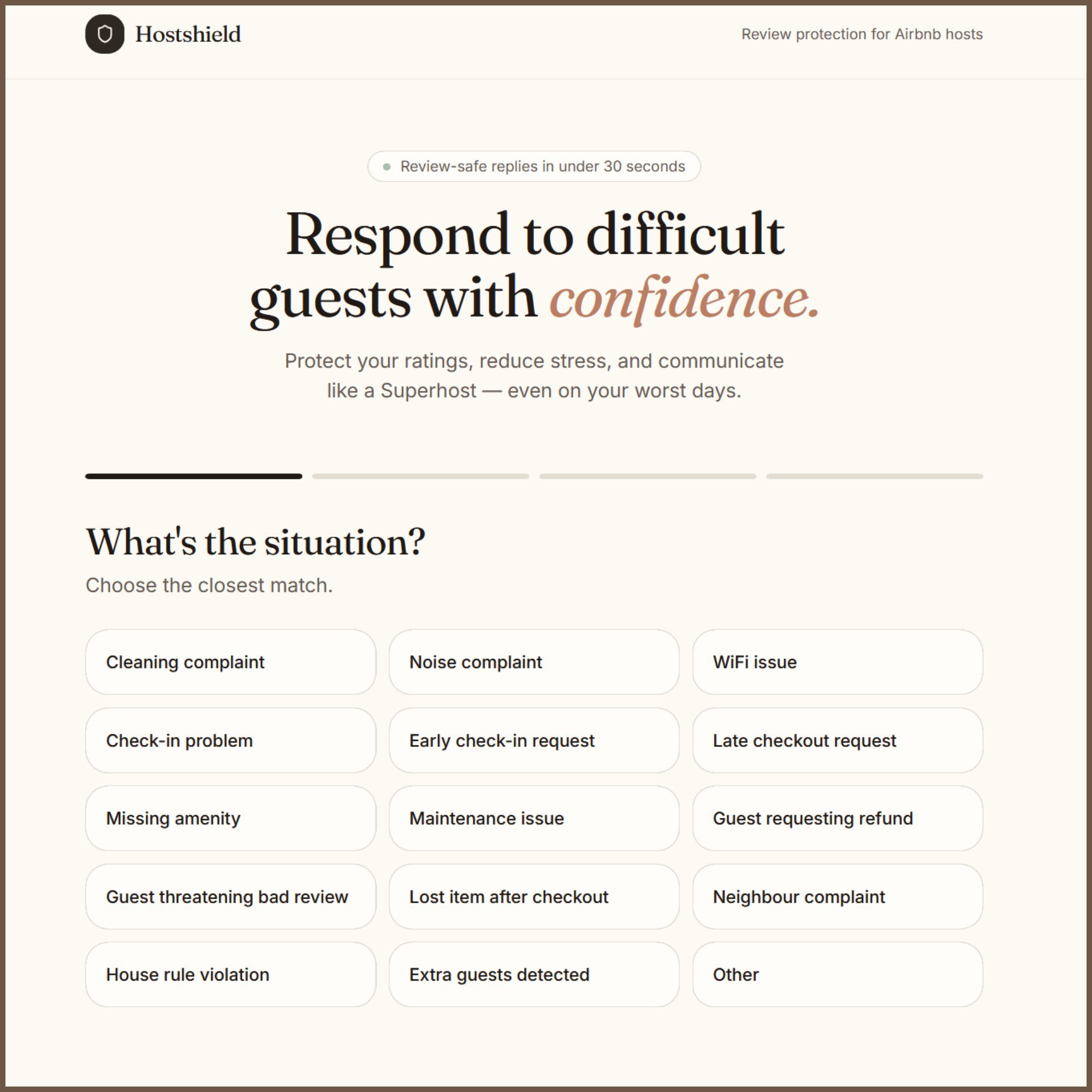
Free Tool: Hostshield AI Guest Response Assistant
Every difficult guest situation is different, and there is rarely one perfect answer. Hostshield helps you think through the situation, suggests professional, review-safe responses, and offers practical guidance based on hospitality best practices.
Use Hostshield as a practical starting point. It can help you think through difficult situations and draft professional responses, but always adapt the suggestions to your own property, policies, and circumstances.

When You’re Clearly at Fault
Sometimes you made a mistake. The cleaner didn’t show up. The heating isn’t working. The photos from three years ago don’t quite match the current reality.
When this happens, the best approach is also the simplest: name it, own it, fix it fast, and match the remedy to what was actually lost.
On apologies: a good one includes acknowledging what went wrong, taking real responsibility, and offering a genuine repair. The strongest elements, according to my research on hospitality service recovery, are taking responsibility and offering repair. What doesn’t work is a weak apology that performs sympathy but avoids ownership — guests read that immediately, and it makes things worse.
Also: don’t repeat the apology instead of making a plan. Saying sorry three times without a concrete next step starts to feel evasive rather than caring.
A host script that actually works when you’re at fault:
“You’re right, and I’m sorry. The apartment wasn’t at the standard you booked, and that’s on me. Here’s what I can do right now: [specific option A] or [specific option B]. Because this cost you time and disrupted your arrival, I’d also like to [matched remedy]. Please tell me which works better for you.”
Specific. Responsible. Fast. No vague reassurance.
Let me give you a real example from our own hosting experience.
We were lucky with our property. In 2 years of hosting, we only had one item broken by guests (a soap jar — easily replaced) and one major appliance failure. But that appliance failure taught me more about guest service recovery than anything I’ve read since.
It was May. We had a solo traveler staying for three weeks — a lovely, quiet guest. Around 10 PM one evening, she messaged to say the dishwasher had stopped working mid-cycle.
My husband didn’t hesitate. Despite the late hour and the 30 to 40 minute drive to our property in Trogir, he got in the car and went. He assessed the situation on-site, couldn’t fix it himself, and first thing the next morning he contacted IKEA, arranged a repair visit, and had a technician there within days.
In the meantime, we brought her a nice box of chocolates. Not as a transaction — not “here’s chocolate so please don’t leave a bad review.” Just as a genuine I’m sorry this happened, and I see that you’ve been incredibly patient.
She had been, by the way. Remarkably understanding. Barely complained. Handled the whole thing with grace.
That guest left the most detailed, glowing review we ever received. The longest one among all our reviews. The one that mentioned me by name. The one that called our house “a beautiful, healing place” with everything “done with love.”
The dishwasher broke. We showed up. That’s what she remembered.
Research calls this the service recovery effect — a genuine, human response to a problem can sometimes produce more loyalty than if nothing had gone wrong at all. I’m not saying break your appliances on purpose. But I am saying: don’t underestimate what showing up, in the most literal sense, can do.
When the Guest Is Wrong (or Partly Wrong)
This is where it gets harder. Because the temptation — completely understandable — is to defend yourself. Immediately. To correct the record. To point out what the listing actually said.
Resist it. At least at the beginning.
The most useful rule in hosting conflicts: validate the feeling, not the inaccurate facts.
If a guest says “this place is completely unsafe” because a porch light is out, you don’t have to agree that the property is unsafe. But you can acknowledge that arriving somewhere dark and unfamiliar at night felt unsettling. That’s the distinction. You understand the experience without endorsing the exaggerated claim.
This matters because emotional validation calms people down — even when you’re not agreeing with their version of events. Once the temperature drops, you can return to the facts together: the listing description, the photos, the house rules, what was disclosed before booking.
When the cause is genuinely outside your control — external construction noise, a city-wide power outage, a weather event — clear, calm explanation genuinely helps. Not as an excuse, but as information that shifts the attribution from “this host is careless” to “this was an unfortunate situation.” That matters for how angry the guest feels.
What about review threats? If a guest says something like “give me a refund or I’ll leave a one-star review,” or very often: “I will give you out on Social media,” this is a specific situation with a clear response. Airbnb’s policy explicitly prohibits guests from threatening reviews to obtain unwarranted compensation — it’s against the platform’s rules. Your job is to stay factual and fair, not to negotiate with threats.
A calm boundary-setting response:
“I can see this has been frustrating, and I want to resolve any real issue fairly. Based on what I can confirm, I can offer [option A] or [option B]. I’m not able to agree to additional compensation tied to reviews, but I’m genuinely committed to finding a practical solution.”
Fair. Firm. Non-escalating.
The Hardest Situation of All: When There Is No Good Solution
Most hosting guides skip this part. Because it’s uncomfortable. Because there’s no tidy script that fixes it.
But it happens. And when it does, you need to know what you’re actually there to do.
I want to share a situation that happened to me in customer service — a situation I still remember after years, because some situations leave a mark.

August 17th. Peak season. A host realized on the morning of a guest’s arrival that he had made an overbooking. The guests — a family of five — had booked back in June. They were an hour away from the accommodation when I made the call.
No apartment. High season. The entire area was full.
I spent the next hour calling every contact I had, trying to find something — anything — for five people. Nothing. In the end, the host managed to arrange two small studios as a temporary solution. Not what the guests had booked. Not what they wanted. Not enough. They accepted it only because they had no choice, and received a partial refund.
But those phone calls. Three times in a row, fifteen to twenty minutes each, with a guest who was completely, entirely right. Right about everything. And nothing could be done.
Until this day, after 16 years, these situations are the hardest for me. Not because I don’t know what to do — but because there is genuinely nothing adequate to do. You become a punching bag for someone’s completely justified anger, and your only tool is to keep showing up on the line.
There is no script that makes this okay. But there is something worth understanding.
When there is no solution, your role shifts. You are no longer a problem-solver. You are a witness. Someone who stays on the line. Someone who says “I know this is not okay” and means it.
Research shows that guests who experience a problem and then feel abandoned experience double damage — the problem itself, and the feeling of being left to deal with it alone. Staying present, even when you have nothing to offer, is itself a form of care. It’s not enough. But it’s not nothing.
The host in that situation blamed the agency. That’s a pattern that happens — displacing responsibility onto a third party to manage the guest’s anger in the moment. It’s understandable. It’s also unfair to whoever absorbs it, and guests usually sense when blame is being shuffled.
What’s honest in an impossible situation:
“I know this is not okay. I know this is not what you planned and not what you paid for. I’m not going to pretend otherwise. What I can tell you is that I’m going to stay with you on this until we find the least bad option available, and I’ll be honest with you about what that is.”
Not a solution. A commitment to stay present. That’s what’s actually available.
And after: these situations cost something. Carrying someone’s legitimate anger for an hour, when it isn’t your fault and you can’t fix it, is genuinely exhausting. Don’t carry it silently. Talk to someone. Write it out. The guests moved on. You deserve to as well.
Some situations leave a mark. That’s what happens when you actually care.
“Some problems are mine to solve.
Some problems are mine to guide.
Some problems are simply mine to witness.
And knowing the difference is part of the job.“
The Five Most Common Scenarios — and What to Do
Guest Can’t Get In
These are disproportionately damaging because guests are already tired, often stressed, and carrying luggage. The worst time to feel lost or locked out.
Rule: restore access or safety first. Explain and discuss everything else second. Don’t get into responsibility conversations while someone is standing on a dark doorstep at 11pm.
The Apartment Isn’t Clean
High-volatility. Cleanliness goes directly to trust and safety — guests won’t reason their way through it, they’ll react.
Don’t debate whether “it’s really that bad” before investigating. One of the most common responses I hear from hosts is: ‘But it is clean. The cleaner was there.’ In reality, cleanliness is highly subjective, and in my experience the guest is more often right than wrong in these situations. Offer an immediate re-clean or a fair remedy based on severity. Airbnb’s guidelines give guests 72 hours to report cleanliness issues, and if you can’t fix it, the platform may get involved. Getting ahead of it fast is always better.
Noise Complaints
First question: is the noise coming from inside your property (controllable) or outside (not controllable)?
If internal — act immediately. Contact those noisy other guests. Explain the house rules. If external — explain clearly and offer practical mitigation: earplugs, a room change if possible, or an honest conversation about options. Clear explanation of an uncontrollable cause genuinely reduces frustration. Silence or vague promises don’t.
Something Stops Working
Three parts, in order: what happened, what you’re doing, when it will be resolved. That’s it. If the fix will take longer than expected, say so early and give the guest a choice — wait for repair, accept a workaround, or receive a partial remedy. Don’t make them fight for options they should have been offered.
“This Isn’t What I Expected”
This is an expectation conflict, not a character judgment on you. Treat it that way.
Start with validation — they’re genuinely disappointed, and that’s real. Then return calmly to objective ground: what the listing said, what the photos showed, what was disclosed before booking. If the listing was accurate, you can stay kind while holding your position. You don’t have to pay to erase a mismatch you didn’t create.
We had exactly this situation with our stone house in Trogir. Guests arrived by car and were visibly upset to find there was no private parking. From their perspective it felt essential — they’d simply assumed it would be there.
But it had never been advertised. Not in the listing, not in the photos.
My husband didn’t get defensive. He calmly showed them the listing, acknowledged their frustration, and then helped them find a nearby spot — including where the paid public options were if the closer spaces were taken. They were still disappointed when he left. And that’s okay.
Disappointment isn’t the same as the host being wrong.
Sometimes the guest expected one thing and booked another.
In situations like these, kindness matters just as much as facts. You can acknowledge the frustration, offer practical help, and still maintain your position.
The goal isn’t to win an argument.
The goal is to help the guest move from disappointment to acceptance without turning the situation into a conflict.
Keeping Your Own Cool
Here’s something experienced hospitality professionals understand that newer hosts often don’t: staying calm under pressure isn’t about feeling nothing. It’s about regulating before you respond.
The single most useful thing you can do when you receive an angry message: pause before typing. Even thirty seconds. Enough to shift out of reactive mode.
A prepared template helps enormously here — not because it removes the human element, but because it gives you a scaffold to work from so you’re not composing from scratch while your heart is pounding.
The most common host mistakes, when you look at the research, are consistent:
- Responding too slowly
- Interrupting or arguing before the guest has had their say
- Apologizing repeatedly without offering a real solution
- Jumping to gifts or freebies before the guest feels heard
- Sounding defensive in a public review response
- Not following up after a fix to confirm it worked
That last one is underrated. Following up after you’ve resolved something — a simple “just checking that everything is better now” — does a surprising amount to restore trust and remind the guest that you’re a real person who cares.
Know your limit too. When your own stress is too high, escalate. To a co-host. To anyone who can step in with a calmer perspective. Trying to manage a serious conflict while you’re emotionally flooded rarely ends well.
After It’s Over: The Part Most Hosts Skip
Once the dust settles, there’s one more step most hosts never take — and it’s genuinely valuable.
Turn the conflict into information.
After each difficult situation, ask yourself a few honest questions: Was this a problem with the property, or with how I communicated? Was the guest mainly angry, or mainly confused? Did things break down at the expectation stage, the response stage, or the remedy stage?
Those questions transform conflict from seasonal chaos into operating knowledge. Patterns emerge. The same complaint showing up twice in one season is a signal. A guest who expected something your listing didn’t clearly communicate is information about your listing.
Complaints, handled this way, are actually useful. They show you what to fix before the next guest arrives.
The Bottom Line
The best hosts are neither submissive nor combative. They’re fair, fast, and emotionally skilled.
They make it easy for guests to feel heard. They make it easy for facts to come out. They make it easy for remedies to be chosen. And they make it very hard for conflicts to turn into ego battles.
That combination won’t prevent every difficult situation. But it will change how those situations end — for your guests, for your ratings, and for you.
And on the nights when there’s no good solution, when you’re holding someone’s anger with nothing to offer but your continued presence on the other end of the line — that’s enough. It has to be. And it is more than most people would do.
After 16 years in tourism, one thing I’ve learned is that great hosts are not the ones who never face difficult situations.
They’re the ones who stay calm when things don’t go according to plan.
Sometimes you’ll solve the problem.
Sometimes you’ll improve the guest’s experience.
And sometimes all you can do is stay honest, stay kind, and stay present until the situation passes.
That’s hospitality too.
Have a difficult guest situation you’ve navigated — or one that still keeps you up at night? I’d genuinely love to hear about it.
And if you’d like to prevent some of these situations before they even happen, check out my free self check-in guide next.
Tools I Created for Airbnb Hosts
We can’t prevent every misunderstanding, complaint, or unexpected problem. But with clear communication, thoughtful systems, and a calm response, we can prevent many issues from escalating in the first place.

Visual Self Check-In Guide
A visual mobile guide designed to help guests arrive smoothly, settle in faster, and find important information without long messages.

Editable Welcome Book Templates
Beautifully designed welcome books that help guests feel informed, comfortable, and genuinely welcomed from the start.

The Cosy Stay Guide
My complete approach to creating memorable guest experiences through thoughtful interiors and practical hosting systems.

Printable Airbnb Signs
Minimal, guest-friendly signs designed to reduce repetitive guest questions while keeping your rental space calm, clear, and cohesive.